Dealer Service Management Tool: John Deere

Disclaimer: Product names, data points, and visuals of this work have been altered to comply with NDA requirements.
- Client
John Deere - Role
UX Designer/Researcher - Categories
Agile UX, Discovery, Design - Dates
May - Dec 2020
The Project
“There’s too many clicks.”
“There’s…there’s what?” - Me
My new Product Manager (PM) tilted her head and gave me an inscrutable look. I had just joined her team 3 weeks ago.
“Too many clicks. Our Dealers keep telling me it takes too long to find what they need in the management queue. That’s something you can fix, right?” - PM
“Oh! Well, to be honest I’m not entirely sure, but I can definitely try!” - Me
This was my first project on the Dealer Service Management Tool (DSMT)*, a complex legacy app meant to help Dealers manage their service departments and the equipment needs of their customers. I was ready to go: a new design challenge, a new team, and a chance to make everyday work easier for people.
Goal 1: Reduce the number of clicks Dealers must take to accomplish their tasks.
Context: Putting the “User” Back in UX
John Deere had recently undergone a digital transformation and as a result was rapidly adding UX designers to embed on product teams. Pre-transformation, “UX” had meant mockups the design team would send along every 1-3 years, so in addition to solving for "too many clicks" I also was intent on adopting a more collaborative, human-centric approach to product development among my team mates.
After that first conversation, I approached my PM:
“So, I know you’re used to receiving mockups from UX for something like this, but I was wondering if we could talk to the Dealers first to learn what’s most important before we design something for them. I can give you a proposal on what I’m thinking about by the end of the week?”
And my PM was on board (aw heck yes)! I began planning discovery interviews that I'd be leading with five of the largest John Deere dealerships.
Goal 2: Understand our Dealers’ key priorities and pain points when using the Dealer Service Management Tool (DSMT).
Goal 3: Help the DSMT team be more collaborative & user-centered during product development.
Why Users Were Unhappy
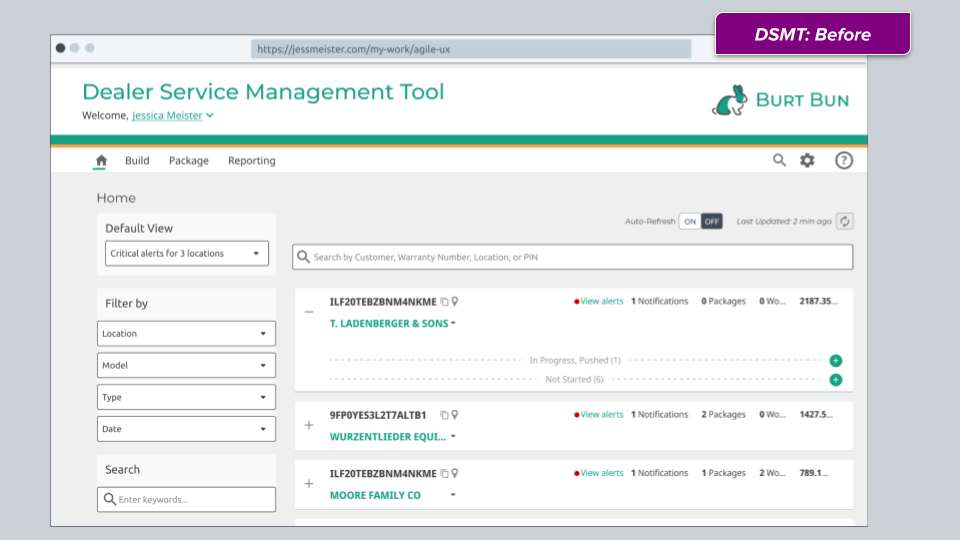
During my interviews with our Dealers, we learned that the most important pieces of information on the DSMT management queue were hidden in multiple, stacked accordion menus, each of which had to be expanded before you could view or open the next one.
One of the Dealers was so frustrated with our tool that he took a screenshot to show us exactly what information he wanted to see where.
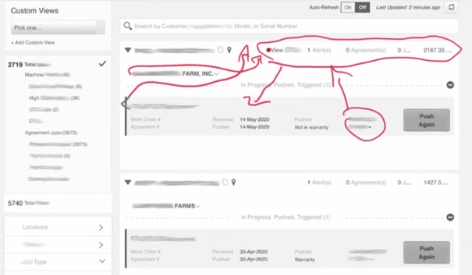
Well, I’d probably be annoyed too. No wonder we’d been getting complaints.
But we had our core problem: Dealers couldn't find the information they were seeking in a timely manner. With these interviews and additional quantitative survey data I gathered, I worked with my PM to define our prioritized list of the most important data points that Dealers referenced as part of their work, and then mapped that metadata directly onto the existing experience to see what was going on.
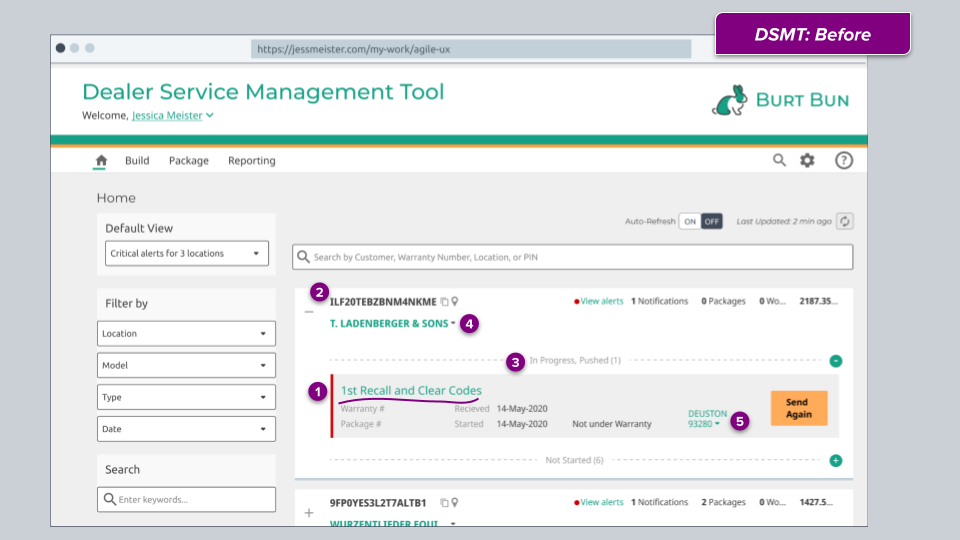
Sure enough, the single most important piece of information to Dealers--the type of equipment service needed--was hidden deep in the second accordion menu of our existing product. Now that was something I was sure we could fix.
Goal 4: Redesign the DSMT service queue to elevate the most important data points.
Approach: Design & Learn Together
As mentioned, my developers and PM had traditionally been excluded from the design process; similarly our users had also not been privy to see work-in-progress out of concern that the lack of polish might reflect poorly on our company.
I understood why John Deere had approached software development this way. It mirrored the slow, careful approach with which we’d always designed and built our high-quality core products: tractors and other large machinery.
But for digital products, this kind of early feedback was vital to ensure our design was both something people actually wanted and something our developers could actually build. So in addition to my standard design work like sketching and building mockups and prototypes, I also led the team through a range of collaborative design activities, including:
- Co-designing possible solutions with my PM in Figma
- Holding design feedback sessions on prototypes with Dealers to see in-progress work
- Whiteboarding & post-up sessions with engineers for critique & work planning
- Iterating on the design during development to accommodate technical constraints
This collaboration resulted in a better design (see Outcomes below), and set the tone for how I hoped to work with my team as the UX Designer on future projects.
Outcomes: Better, Faster, Stronger 🤖
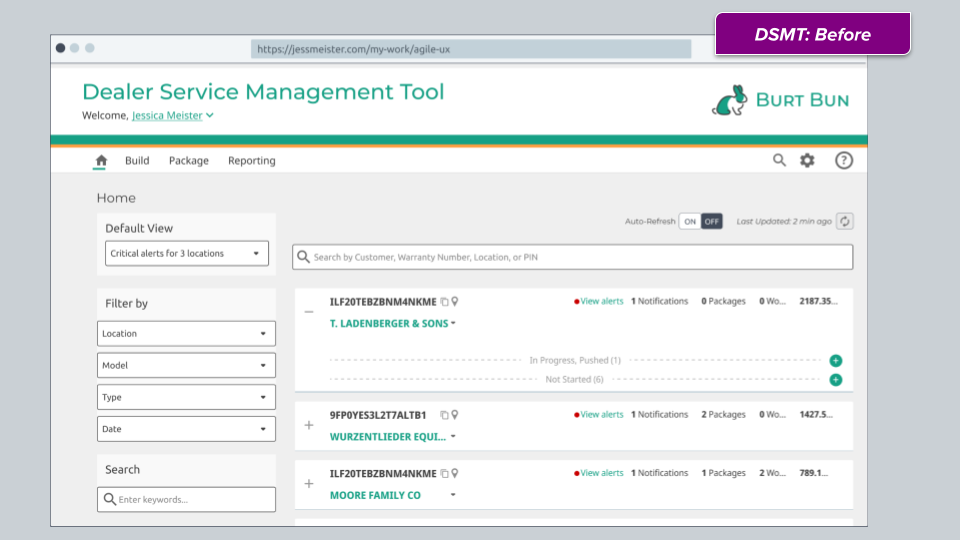
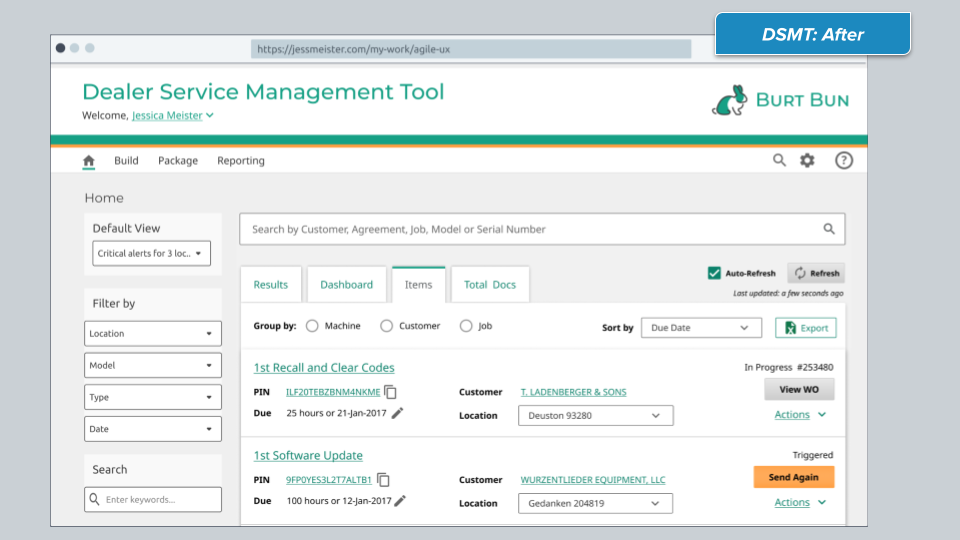
Goal 1: Reduce the number of clicks Dealers must take to accomplish their tasks.
Outcome: The number of clicks required to see the most relevant data reduced from 2 clicks down to 0.
Goal 2: Understand our Dealers’ key priorities and pain points when using DSMT.
Outcome: With the input from our Dealers, I prioritized 15 possible data points in the management queue by both importance and frequency. The key pain point was that some of the most important data points were needlessly buried in a complex UI.

Goal 3: Help the DSMT team be more collaborative & user-centered during product development.
Outcome: Because both the PM and our engineers were involved throughout the process, our team was able to move quickly into development and I gained credibility as a trustworthy UX Designer. Additionally, every backlog item we tackled that sprint was tied directly to the user value, a first for the team.
Goal 4: Redesign the DSMT management queue to elevate the most important data points.
Outcome: We measured the new workflow to be 4x faster for Dealers using the management queue, and we also stopped receiving Dealer complaints about there being “too many clicks” on DSMT.
*Note: Names, branding, and other information have been changed to protect intellectual property.