Building a Remote UX Community of Practice
Background
In 2020, John Deere was in the throes of a digital transformation (and oh yeah, and a global pandemic), heavily focused on accelerating teams with agile practices. Also true at the time: there was no central organization around the role of UX or how it was meant to influence product development that was now expected to deliver at a more rapid clip.
Around this time, my tech organization began to understand that a shared-service UX team of 10 people was not able to support the hundreds of products and 3,000+ engineers in its remit. Some teams began trading an engineering headcount to hire their own designers, and it was in one of these new design roles that I joined as the sole UX-er supporting 3-5 dealer service teams.
There were 12 of us spread across half a dozen departments, but we’d been given no guidance and had no leaders: most of us reported up through engineering, after all. It was clear that if the company wasn’t going to create opportunities for us to grow, we’d need to do it ourselves.
And so, in May 2020, fresh off of being sent to work-from-home, I invited a dozen UX professionals to yet another Zoom call so we could try to figure out exactly what we wanted our “community” to be. We called ourselves the “UXplorers.”
Starting Out
Without any shame or irony at all, I kicked off our first meeting by sharing a definition I’d googled of what it actually meant to be a Community of Practice:
Community of Practice (CoP): A group of people who share a concern or a passion for something they do and learn how to do it better as they interact regularly.Etienne and Beverly Wenger-Trayner, 2015
We at least knew our Domain: Product team designers and researhers, and I knew from other company guilds that the Community part usually was a Lean Coffee-style meeting. I figured the “Practice” part would figure itself out eventually.
As folks discussed their thoughts in the kickoff, I quickly realized that a Lean Coffee was going to be too little, too bite-sized for sharing knowledge and helping each other grow.

Our biggest challenge as UX professionals was that we didn’t know how to navigate this weird new space of working with agile teams without sacrificing rigor and product quality…that wasn’t something we could discuss properly in just 5-10 minutes per topic.
Lesson 1: Learn how other Communities work, but do what makes sense and leave what doesn’t to keep it useful for the people who want to join you.
By the end of the brainstorm, we had some Community Goals (below) and I had enlisted two other folks willing to figure out a better, non-Lean Coffee format suited to us.
UXplorer Community Goals
- Get to know the other UX Product people (in both professional & casual contexts)
- Learn what others are doing (research, design, process, etc.) and use or adapt it for your own space
- Solicit and share feedback on work-in-progress
With those concepts in tow, I kicked off our new UXplorers Community sessions, excited about the people we’d met and hopeful for what was ahead.
Finding Our Groove
After our first few Zoom calls, I started receiving messages from members about how deeply they appreciated the space we'd managed to build, how special it was. We had a place to hang out and learn from others in our profession, but without the stress of “job performance ratings” or the occasional competitiveness that can happen on Design teams.
What I hadn’t foreseen is that suddenly we all had access to UX-ers with expertise in a range of areas: analytics, Scrum practices, front-end development, journey-mapping, quantitative marketing data, virtual workshopping...the list goes on.
Lesson 2: If you love learning, spend just 30 minutes listening to a peer share their real-world experiences on how they practice design or research at your company. I guarantee that it's worth your time.
The UXplorers began reaching out to each other after each session to dive deeper or loop in product owners and developers. We started sharing the templates we’d all built for creating UX artifacts, now suddenly possible and quick-to-realize in a way that was previously unreachable due to time constraints.
As more UX headcount got added, more UXplorers joined and others would introduce me as "leader of the UX Community of Practice.” In my mind, I was just scheduling/facilitating meetings and encouraging people to share their work. But one of the my close colleagues pointed out that we wouldn't be here at all if I weren't doing exactly that, so:
Lesson 3: Sometimes, “leadership” is just being willing to put in the time and make it actually happen.
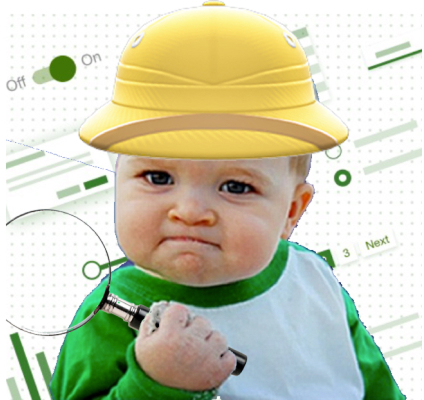
Throughout this period, we iterated on our meeting format to keep us learning about our field and about each other. It was during one of our Zoom socials when we chose the name “UXplorers,” representing our shared curiosity and the unknowns ahead, complete with a design-workshopped meme for our group.
Looking Ahead
As of this writing near the end of 2021, the UXplorers have been active and growing for just around a year and a half. I still regularly have members who message me and tell me how grateful they are for the support this community provides, some of them calling it their “favorite meeting, hands down.” High praise for a Zoom call, but I can’t disagree.
I sincerely believe I’ve grown more as a UX professional while leading this group of people than at any point prior in my career. Some direct outcomes I had from sharing and learning in this group include:
- Got buy-in for soliciting user feedback on low fidelity prototypes (a hard sell in an otherwise high fidelity organization) after sharing the success another team had in doing so.
- Mentored a handful of junior and mid-level designers on presenting their work to others more effectively (and properly adapting to their audience).
- Led panels and talks on dual-track development to help designers work more effectively with their agile teams.
We are just now beginning to look at that last piece of our Community of Practice: the “shared repertoire of resources: experiences, stories, tools, ways of addressing recurring problems” -wenger-trayner.com. And as we head into the next year, the UXplorers have added another goal to our list:
- Begin to understand how we might strategically grow in our careers
While I’m not sure we know how to do that today, I’m confident we’ll be able to figure it out if we move forward with the same curiosity and sincerity we started with a year+ ago.
The designers and researchers in this Community are some of the most incredible people I’ve ever met, and I’m so grateful I decided to get us all together in that Zoom call a year ago. I’m a better designer for it and have also made some true, lifelong connections.